Cities need vegetation and green areas for comfort and well-being, but also to mitigate the effects of the climate crisis. In this article, we present four ways Forum Virium Helsinki has promoted the development and planning of a green city together with the city and its residents.
Urban green spaces and plantings have long been a factor in pleasant living environment. With climate change and biodiversity loss, cities have realized that green is also a necessity. Sufficient vegetation cover helps with adaptation, for example by mitigating urban floods and heatwaves. It increases species diversity and, at its best, strengthens carbon sinks.
The European Union’s Nature Restoration Law highlights the benefits of vegetation for cities. The regulation is one reason why Helsinki and its innovation company Forum Virium Helsinki have invested in recent years in ways to increase vegetation. The innovation company’s two- to three-year projects funded by the European Union have often been related to urban greenery. The goal is for Helsinki and other cities to find new greening methods through these projects. Sometimes this has meant living plants for areas awaiting renovation, and at other times developing design tools.
Below, we present four ways we have influenced Helsinki’s greenery.
1. A green city is created on the drawing board
Green neighborhoods are best created when vegetation is taken into account as early as when the area is being planned. Still, in Helsinki and other European cities, new residential areas in recent years have not included nearly as much urban greenery or trees as city residents would have hoped. One deficiency may lie in design tools.
Forum Virium Helsinkihas tested and developed methods for planning green infrastructure in many projects. One example is planning green infrastructure for Hermanninranta. We were involved in it through comprehensive digital modeling utilizing a game engine. The modeling included, among other things, 3D versions of trees reflecting seasons and growth rates. They helped reveal how trees look in space, how they change the environment as they grow, and how they shade buildings in different seasons and at different ages.
In addition, a plant library containing 3D models of local plants and their growth was developed during the planning phase. The City of Tallinn also benefited from the plant library later because they have a lot of similar vegetation to Helsinki. The 3D model was perceived as a clear and easily understandable way to present urban greenery.
2.Vegetation improves the image of one’s own neighborhood
Typically, innovation company projects aim to improve urban residents’ quality of life. Therefore, many experiments invite residents to share their opinions and participate in development work. Oases, or green stops have been located at Ylä-Malmi square and in Kannelmäki over several summers. They have reminded residents that renovation work is coming to the area in the coming years and provided opportunities to start conversations about future changes.
In Malmi, Kalasatama, and Longinoja, among other places, residents’ hopes and thoughts regarding local nature have been collected. In Kalasatama, residents got to try out an augmented reality tool to see where trees and other vegetation could be placed. In Longinoja, Local Nature Nights have informed residents about regional zoning work while residents in turn shared thoughts on what is important to them in local nature. Forum Virium Helsinki helps ensure that residents’ needs and wishes remain part of regional planning work.
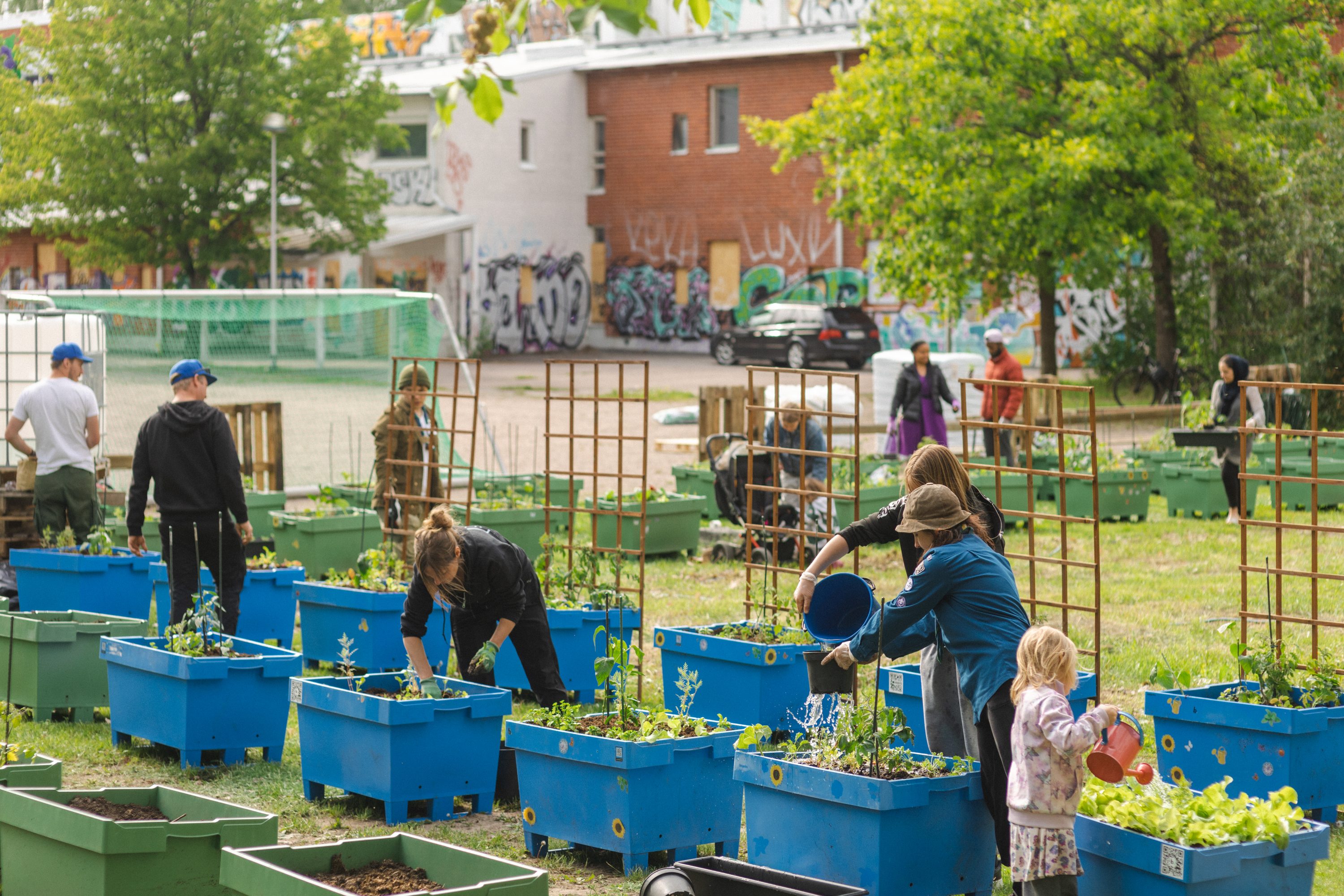
When testing greening solutions, working with residents means that occasionally Helsinkians get to get their hands dirty in the soil. Such experiments have included community gardens in Malminkartano and in housing association yards.
The Ilmalankeidas experiment implemented in summer 2025 greened an empty square and brought together employees from surrounding offices for events and plant care activities. The experiment encouraged companies in the city to realize that they too can take ownership of urban space. Lessons from the experiment were utilized in summer 2026 at Porvoo market square. In many experiments, taking care of plants has fostered community spirit in neighborhoods, which in turn has shifted attitudes toward one’s own living area in a more positive direction.
Urban squares like these are common space for everyone, and we want to support people’s opportunities to influence their own environment
Jani Päivänen, Team Leader in charge of the project at Sweco
3. Data and models on the benefits of green spaces
Data provides situational awareness and helps in decision-making when filtered and interpreted properly. Based on it, work can be planned and prioritized, and the city developed. The data-based innovations we tested have shed light on the effects of the climate crisis on people’s lives and residential areas, the benefits of vegetation, and the impact of temporary plantings on biodiversity. For instance, data collected from Kallio summer streets in 2025 and plant-covered bus and tram stops showed that pollinators visit even temporary plantings.
Recently, we visualized the importance of green structure in climate change adaptation through a demo tool. At the same time, we highlighted which residential areas heat and urban flooding are likely to impact people’s lives the most. The demo tool is still under development, but it is already a useful tool for the city to examine regional differences.

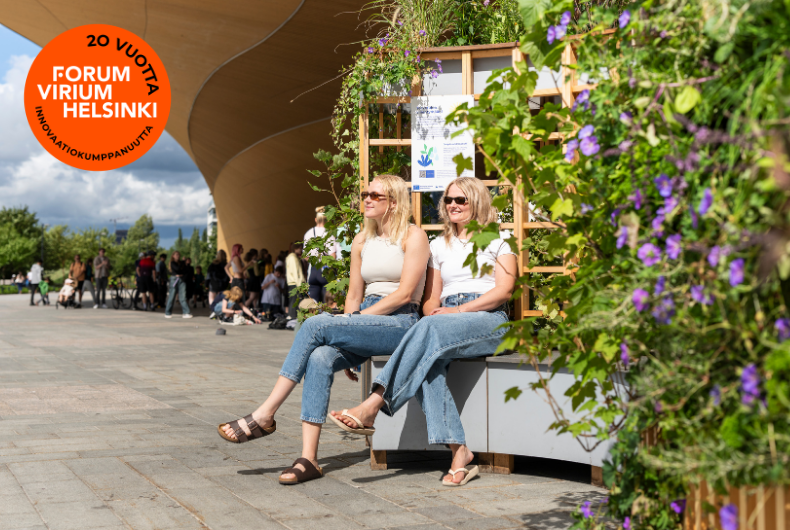
Simple measurement results can also be significant for the city. In summer 2025, satellite data was utilized in lawn maintenance work. In August 2026, a cooling point erected in front of Central Library Oodi and a meter attached to it showed that temperatures experienced amidst vegetation and cooling mist can actually be 5–10 degrees lower than outside the point.
Although the cooling point doesn’t solve everything, it highlighted problems caused by heat.
We have noticed that elderly Helsinkians arrive at the library with packed lunches early in the morning during heatwaves. They look for seats near the air conditioning and spend the hottest hours here
Kari Lämsä, Service Manager at Helsinki City Library
4. When greenery is lacking, temporary solutions help
In the 2020s, temporary greenery—such as green walls, plant-covered public transport stops, and seating areas on summer streets—has become more common in the urban landscape. We at Forum Virium Helsinki have experimented with temporary greening for years across Helsinki and helped companies develop various implementation methods. Some experiments have utilized soil and plants moved from nearby construction sites. Others have developed efficient watering systems, and still others searched for plants suited to northern conditions.
Temporary greening experiments have taken place in Kalasatama, Herttoniemi, Kannelmäki, Malmi, Malminkartano, and in front of Oodi, among other locations. In Malminkartano and Kannelmäki, the city continued temporary greening even after the trial period. The green tram stops on Hermannin rantatie were also continued and Kaupunkiliikenne Oy ordered more of them for use.
In previous summers, the stop greening solutions have looked really fantastic and enhanced the area’s pleasantness. They have received great feedback.
Leo Hakkarainen, Lifecycle Specialist at Kaupunkiliikenne Oy
While temporary solutions do not replace permanent ones, they still supplement the green network, support species diversity, and serve as a reminder of the importance of green spaces. Furthermore, temporary greenery works well in waiting situations, such as when permanent plantings are still small and young or when an area is under construction and renovation.
Read more about work for a greener city:
Header photo: Sakari Röyskö