
Over the past seven years, we have successfully tested the use of drones in numerous vital functions across Helsinki. We have found that drones can improve Helsinki’s security of supply, help reduce traffic emissions, and even save lives.
The most important part of our work is helping Helsinki adopt this new technology and build an urban aviation strategy – by experimenting agilely and carrying the risks of these pilots. In addition, an essential part of our work is listening to the opinions of Helsinki residents and building a knowledge base and experience together with other European cities. This is the story of the seven-year drone journey of Helsinki’s innovation company, Forum Virium Helsinki.
- Fast emergency care to hard-to-reach places
- Aid for maritime rescue operations
- Security of supply by air
- Aerial photography for real-time data on a changing city
- Traffic planning for emission reductions and safety
- Cooperation and public acceptance
Fast emergency care to hard-to-reach places

Something curves toward us from the crisp, freezing sky above Suomenlinna. The device lands, an adrenaline pen is retrieved from its compartment, and it is administered into the thigh of someone suffering an allergic reaction. Help has arrived in a remote corner of the island in just a few minutes. This enacted use case, executed with a real drone, was filmed by an MTV3 camera crew.
While we are flying an EpiPen from the mainland to an island, a drone pilot in Germany transports blood from an operating room to a laboratory, and an automated external defibrillator (AED) is flown into the middle of a field in Norway. We ourselves tested drone delivery of an AED at Malmi Airport a few years earlier. And before Jätkäsaari got its first pharmacy, we used drones to transport pharmaceutical products to the district from Lauttasaari.
The historic flight to Suomenlinna during the AiRMOUR project in 2023 is the culmination of all our drone work to date. It and the guide we published on integrating urban air mobility inspired the City of Helsinki to initiate a vital urban aviation plan. No one wants drones flying and landing uncontrollably in residential areas.
“Without AiRMOUR, advancing the drone sector in Helsinki would have taken much more time,” said Christina Suomi, Head of Unit at the City of Helsinki’s Urban Environment Division, at the end of 2023.
The following year, the Urban Environment Division allocated staff for the first time to work on urban aviation and the U-space project, led by Christina Suomi. Through this project, Helsinki aims to achieve a safe and functional urban airspace.
“Forum Virium’s work in urban aviation-themed EU projects was important in creating a vision and network.”
– Christina Suomi, Head of Unit, City of Helsinki Urban Environment Division
Aid for maritime rescue operations

It is an autumn day in 2024. A person who has fallen into the water waves frantically in the sea off the coast of Vuosaari Harbour. Then, a drone glides over the drowning person and drops its payload to assist them. The staged scenario ends happily. The person in distress is quickly rescued thanks to a rescue buoy flown to the scene. And YLE’s radio journalists get an exciting segment for their program.
“Drones are a functional addition to rescue operations. With their help, a person in need of assistance can be located quickly in many situations,” says Petri Korhonen, Fire Captain of the Helsinki Rescue Department, who participated in the trial.
Security of supply by air

First went blood, then rescue buoys – and now hand sanitizer and rubber gloves. We are not throwing in the towel (or the gloves). Not even though getting a flight permit for a seven-kilometer journey over Mustikkamaa takes several months. This is also part of piloting; we gather lessons for the future from this as well. Ultimately, we adjusted the flight schedule slightly.
In the 2025 pilot, we test security of supply logistics by transporting medical supplies via drone from Stara’s warehouse in Kyläsaari to the Laajasalo health station. A journalist from Helsingin Sanomat follows the operation. In addition to Stara, the City of Helsinki’s Social Services, Health Care, and Rescue Services division is also involved in the cooperation.
“I look forward to this becoming our new normal in the near future.”
– Sami Aherva, Director of Logistics Unit, Stara
Aerial photography for real-time data on a changing city
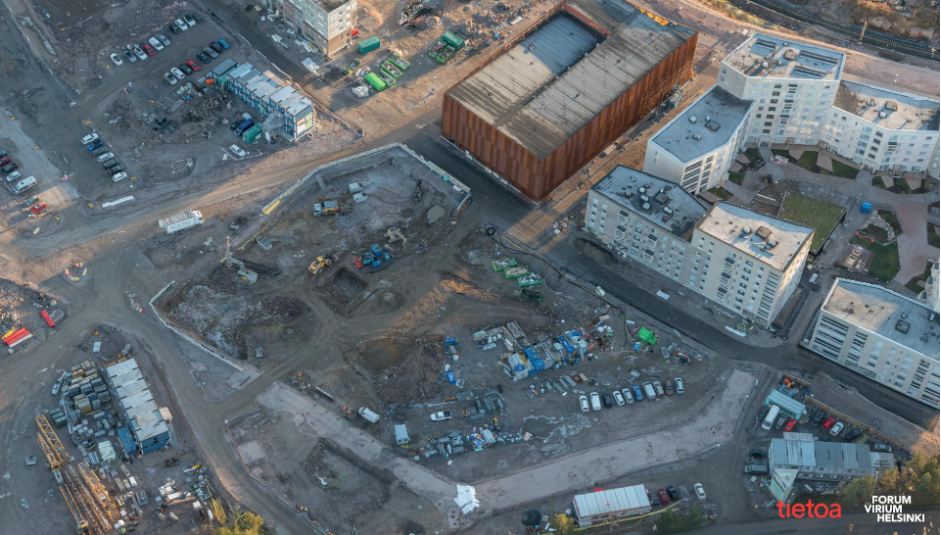
Traffic arrangements in new residential areas, the locations of roads, walking routes, and signs change rapidly, causing hassle for local logistics and residents, as map applications are updated relatively infrequently.
Aerial photography conducted with drones has proven to be an invaluable tool, especially in rapidly developing residential areas, such as Postipuisto in Pasila, where we conducted drone photography during the area’s construction phase in 2022. The data collected from the air serves not only planners but also resident communication, as it provides a clear and up-to-date picture of the construction’s progress.
In the same year, we also experimented with combining augmented reality (AR) technology with drone photography in green environment modeling. With these technologies, data about trees and other vegetation can be anchored directly onto the digital twin with unprecedented accuracy.
Already in 2020, we tested drone services for targeting nature management, assessing storm damage, and creating situational awareness for oil spill response in cooperation with Stara and the Rescue Department, as well as counting nesting barnacle geese on Harakka Island.
Traffic planning for emission reductions and safety

As a cruise ship reverses toward the terminal, the West Harbour area begins to fill with passenger cars, taxis, and buses. Passengers with suitcases and cases of long drinks rush from the terminal toward trams, while those with less luggage head home on foot, by personal or city bike, or on electric scooters. In addition to passenger traffic, dozens of trucks with exhaust clouds snake out from the depths of the cruise ship into the streets.
The pilots we carried out already in 2021–22 showed that drones remotely controlled over a 5G connection could replace expensive fixed traffic counters. Now, in September 2025, we are flying drones over West Harbour for the third consecutive year to film traffic congestion. The video collected from a bird’s-eye view is used to develop AI-based simulation models, helping traffic planners better anticipate traffic jams, promote sustainable mobility, and test new solutions.
An MTV camera crew is busy filming the drones at West Harbour. Our Program Director, Minna Torppa, is interviewed the same evening on the live broadcast of the Viiden jälkeen show. The trial also makes the news on Euronews, reaching an audience of over one hundred million. Once again, we are at the forefront of something internationally significant.
The significance of the pilots carried out by Forum Virium is also emphasized by the city’s leadership. Ville Lehmuskoski, Executive Director of Helsinki’s Urban Environment Division, describes the strategic potential of urban aviation as follows:
“Space is the most limited resource in a growing city. The great potential of urban aviation lies in the fact that, in addition to the ground level, we can utilize the third dimension, which creates new space for transport and logistics.”
“Urban aviation improves the reliability of the transport system, the predictability of deliveries, and resilience.”
– Ville Lehmuskoski, Executive Director, City of Helsinki Urban Environment Division
Cooperation and public acceptance
In these drone projects, our partners have included various divisions of the City of Helsinki, the city’s construction service enterprise Stara, the Rescue Department, the Port of Helsinki, and the VTT Technical Research Centre of Finland. In Europe, we have engaged in drone cooperation with companies, research institutes, and cities in Sweden, Norway, Germany, the Netherlands, Estonia, and Latvia, among others. By next year, we will expand our cooperation with Finnish companies by building new business opportunities in the drone sector within the capital region.
None of the aforementioned innovation work has been done without the approval of Helsinki residents; over the years, we have surveyed the social acceptance of drones more than anyone else in Finland. The acceptance of new technology is built on transparency. According to the latest surveys, as many as 91 percent of citizens would welcome a drone near their home in an emergency. Monitoring the state of the environment also received strong support at 53 percent. The research results speak for themselves: Helsinki residents widely trust drones – as long as they are controlled by the city or other authorities.
The next step
The suitability of drones for important city use cases is now well known, and the era of pure experimentation is over. The next step is moving toward wider deployment, and integrating urban aviation into urban planning processes is no small undertaking.
In the West Harbour pilot and our sensor network trial in 2025, we learned about recurring GNSS positioning interference: the jamming occurring in the Gulf of Finland reaches the flying altitudes of drones. It is possible to map interference-free areas by utilizing existing sensor networks and digital twins.
We continue to support the City of Helsinki – as a strategic partner – toward broader deployment.