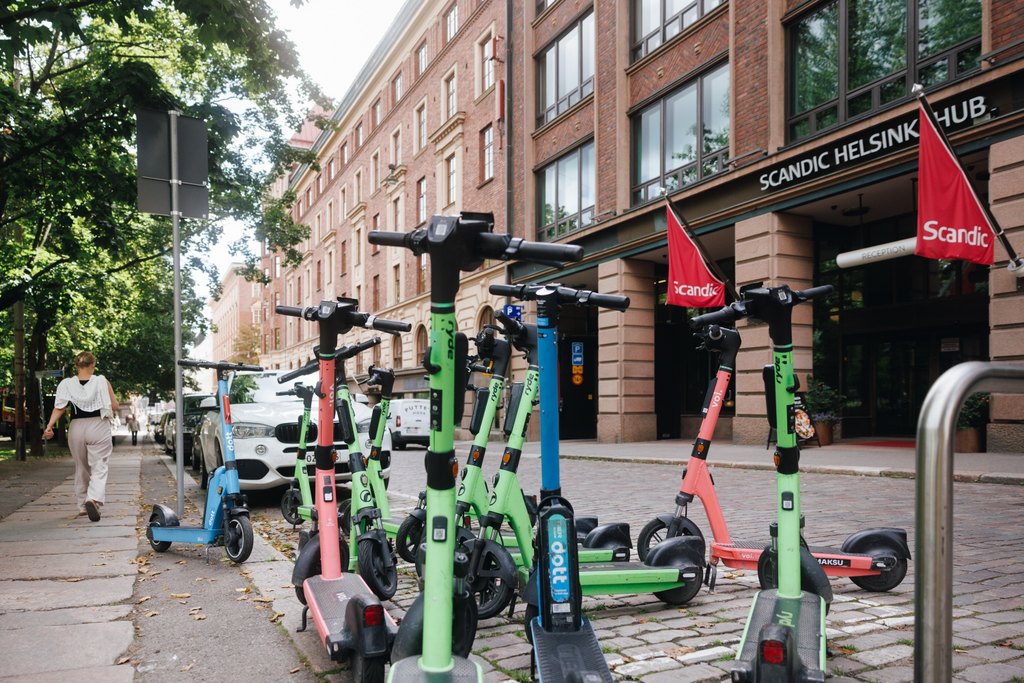

During the summer of 2026, Forum Virium Helsinki, the innovation company of the City of Helsinki, and AI company Emblica Oy tested new technology for monitoring micro-mobility parking. The progress of the trial has also been followed by the City of Helsinki, which provided expert insights and input on city needs.
Over the years, Helsinki has implemented numerous measures to improve e-scooter parking..
“In a few locations across the city, parking e-scooters in bicycle racks has already been tested. This new pilot will provide valuable data on how the parking of e-scooters and bicycles can be integrated in the future,” says Jere Sipponen, traffic engineer at the Urban Environment Division of the City of Helsinki.
“Especially in the busiest areas, incorrectly parked or fallen scooters can obstruct pedestrian flow” notes project manager Noora Reittu from Forum Virium.
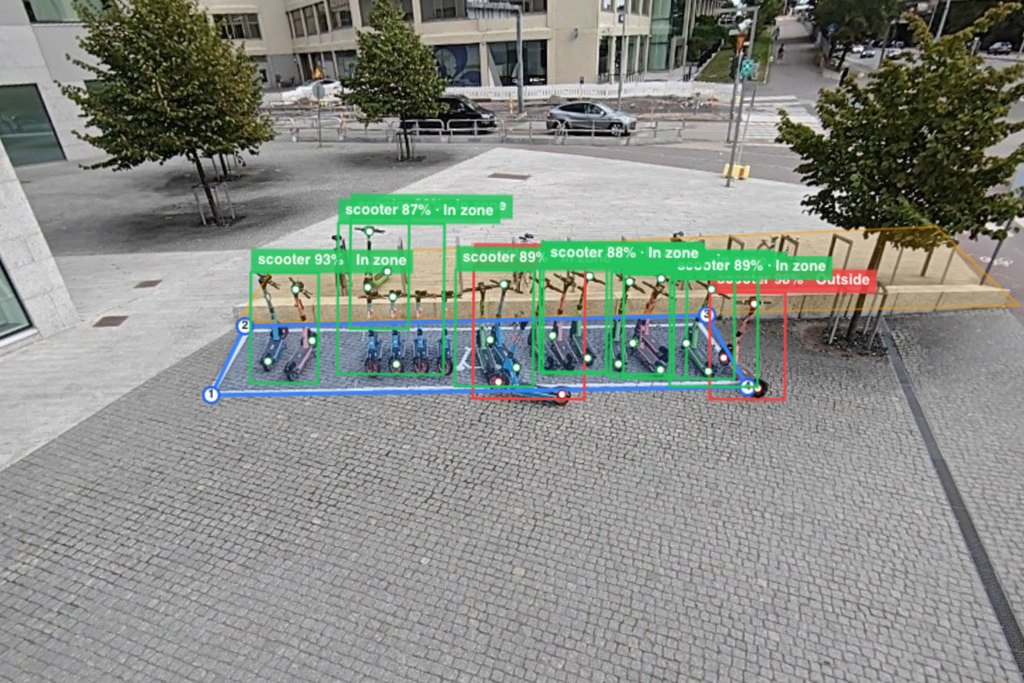
In the Parkkivahti pilot (Parking Monitor), an AI camera solution monitors the parking of e-scooters and bicycles in real time at selected parking spaces. At the same time, data is collected to support urban planning and infrastructure development. The Parkkivahti system is being tested in two locations in Helsinki that differ significantly in nature:
- Vääksyntie 2 (parking space next to bicycle parking): Focuses on assessing whether the AI system can distinguish and count the numbers of bicycles and e-scooters separately.
- Edge of Old Church Park, Annankatu (marked parking space): At this popular parking spot, the pilot assesses how effectively the system detects vehicles inside and outside the designated area as well as fallen scooters.
Do e-scooters take up space from bicycles?
The pilot aims to determine whether e-scooters take up too much space from designated bicycle parking when both vehicles share the same areas. In addition to e-scooters, Emblica’s scalable AI model also identifies bicycles, allowing for precise tracking of the situation.
The choice of pilot locations aims to answer a timely urban planning question: how do shared e-scooters affect bicycle parking? In Stockholm, for example, e-scooters have been directed to bicycle parking spaces.

Predictive data for infrastructure – privacy first
The Parkkivahti system consists of an Edge AI camera and an intelligent backend system. The equipment has been trained with 3D-simulated synthetic data, which speeds up deployment without requiring extensive on-site image data collection. In real time, the system can analyze whether a parking space is truly full or if fallen scooters are occupying extra space.
“Using edge computing and machine learning models, we can analyze valuable data for the city to support decision-making and traffic arrangements, while taking privacy into account,” states Emblica’s machine learning engineer Markku Leppälä.
Computer vision processing takes place locally on the device, and video footage is neither storednor transferred to the cloud. An anonymizing model is used during installation, and only anonymous count and location data are saved to the cloud service.
The pilot is coordinated by Forum Virium Helsinki’s ELABORATOR project, which aims to promote safe, inclusive, and sustainable mobility in cities. The project receives funding from the European Union’s Horizon Europe innovation programme. According to the preliminary schedule, the pilot period and real-time data transfer take place during the summer of 2026, with final results ready by early autumn.
Photos: Vesa Laitinen
Additional information

Noora Reittu
Senior Project Manager
+358 40 848 1343
noora.reittu@forumvirium.fi

