Inspiration from other cities
Espoo’s New Data-Driven Management Tools in Welfare Services

City of Espoo data catalogue
In line with its digitalization priorities, the City of Espoo is developing a data-driven, proactive, and smart city. One of the city’s strategic digital priorities is to systematically utilize data in managing services and development, shifting the focus from outputs alone to measuring actual impact.
Espoo has been developing impact-driven management through systems thinking since 2019 in cooperation with VTT Technical Research Centre of Finland. The operating model has also gained international recognition: in 2024, Espoo’s model was named a finalist in the globally acclaimed World Smart City Awards, selected from among 429 candidates across 64 countries.
Data quality and governance in self-service analytics play a key role in impact-driven management. The Espoo Datahub operating model, data playbook, and data catalogue—developed to support data-driven management—streamline practical data collection. A good example of this is the framework developed by the Sports and Exercise Services unit.
Espoo Datahub and Data Catalogue Supporting Information Use
The architecture of the Espoo Datahub operating model is based on a Hub & Spoke model. In this model, a centralized “hub” provides shared infrastructure and services, while decentralized “spokes”—individual units and sectors—can independently develop and utilize their own solutions while following common practices.
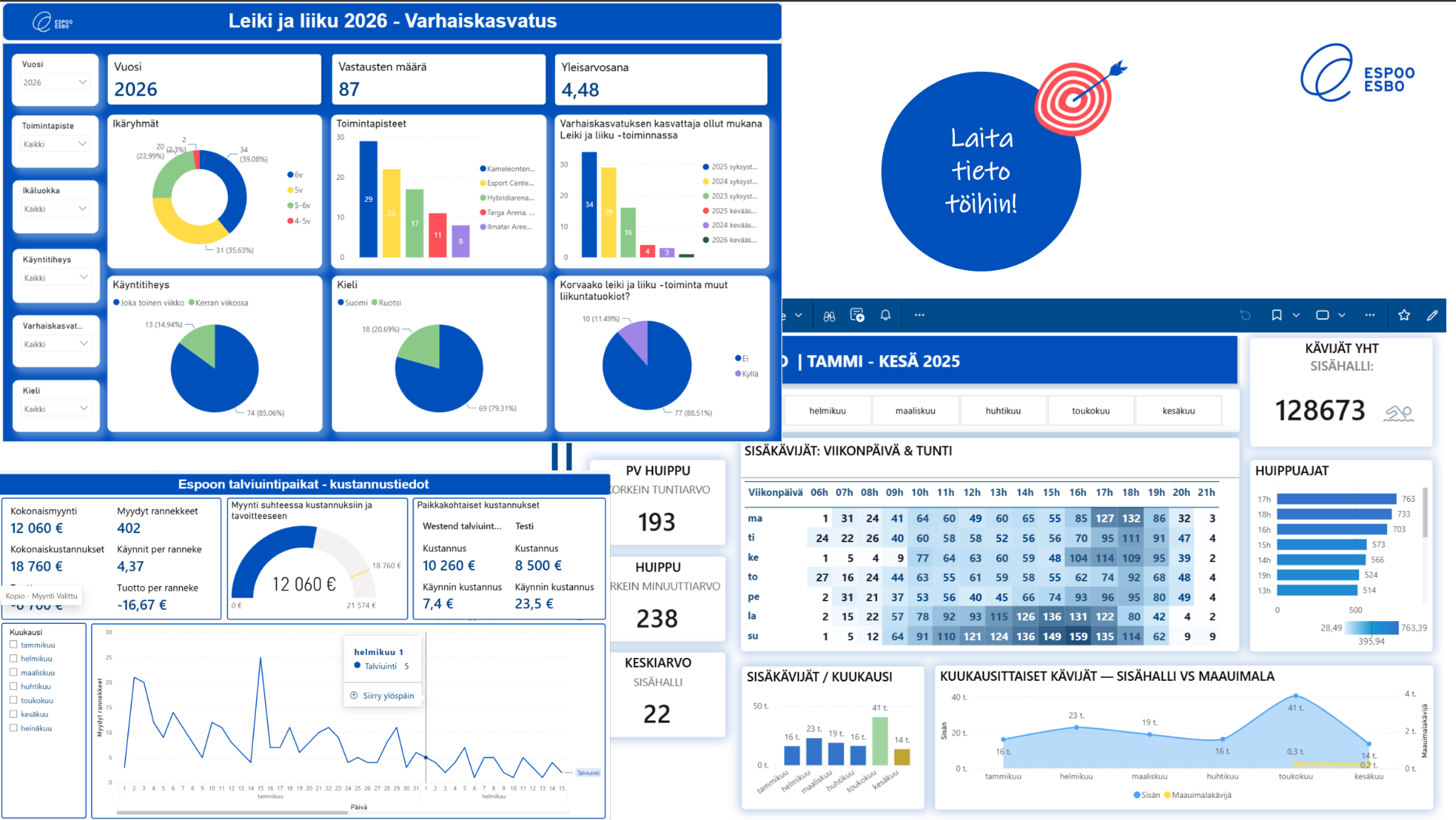
To support practical work and self-service analytics, a data catalogue was created with the core idea of lowering the threshold for data usage for non-technical users. Key benefits of the data catalogue for the City of Espoo include:
- Reducing data silos, duplicate reporting, and unnecessary inquiries.
- Making report background data completely transparent.
- Freeing up time from searching for data to performing actual analytics.
- Making connections between different datasets visible.
- Better targeting resources based on actual data usage.
Example: Sports and Exercise Data Pool
Konkreettinen esimerkki Espoon tiedolla johtamisen mallin jalkautumisesta on Liikunnan ja urheilun tulosyksikössä parhaillaan kehitettävä data-allas (huom, allas terminä kuvaa myös liiA concrete example of implementing Espoo’s data-driven management model is the data pool currently under development in the Sports and Exercise Services unit (note: the word “pool” also plays on swimming facility operations). The goal is to consolidate sports and exercise knowledge management into a single location, enabling better resource allocation, long-term forecasting, and precise tracking of cost-effectiveness. The data pool incorporates a wide range of internal and external data sources, IoT and observation data, statistics from clubs and partners, and resident surveys.
The plan is for the sports data pool to be built around the following key data domains:
- Sports and Exercise Facilities
Includes data on facilities, outdoor recreation, site usage rates, and regional analyses. - Services and Exercise Behavior
Data on instructed and self-directed exercise, swimming lessons, and general service offerings. - Partnerships
Gathers data on sports club activities, events, and resident participation. - Finances
Combines costs, efficiency, and resource allocation.
The development of the data pool and its initial pilots are scheduled for 2026. In 2027–2028, data sources will be integrated more broadly and the data pool will undergo further development. From 2029 onward, the solution is intended to serve as a strong foundation for operational monitoring, decision-making, and development. The data pool is not directly accessible to businesses, but data gathered there could be shared externally on a case-by-case basis in the future, such as with sports clubs.
Practical Data Analytics: Cameras and Wristbands in Swimming Pools
The data pool is fed by precise grass-roots pilots. In 2025, Espoo utilized AI-assisted high-performance computing at the Leppävaara swimming hall. The technology made it possible to monitor visitor flow, headcounts, and occupancy rates in the diving pool (deep multi-purpose pool) at different times of day. Based on this monitoring, the necessity of diving pools can be assessed using empirical data when planning future swimming halls.
Another example is wristband data tracking at the Westend winter swimming location, which enables analyzing visitor numbers relative to overall costs—thereby verifying the exact cost per visit and service impact. In the autumn, data collection will begin across other winter swimming locations, enabling comparisons of visitor numbers and cost-efficiency between sites.

HyteData 2.0 and an AI-Assisted Future
In addition to sports data, Espoo is leading the HyteData 2.0 project during 2025–2026, which seeks solutions for data-driven management across organizational and sector boundaries. The project promotes the creation of a unified, broader regional health and wellbeing (hyte) knowledge base in Western Uusimaa.
The HyteData 2.0 project also includes a health and wellbeing data analysis pilot targeting young Espoo residents with immigrant backgrounds or those at risk of marginalization. The pilot addresses the challenges of utilizing and combining data in a multi-actor environment that includes municipalities, wellbeing services counties, educational institutions, and NGOs.
Espoo is also purposefully promoting the use of artificial intelligence to further enhance data discoverability and analytics.
Read more about the topic:
We lead with impact: We develop sports facilities and services in a knowledge-based manner
Espoo only Nordic city in World Smart City Awards final
For more information, contact: [email protected]
